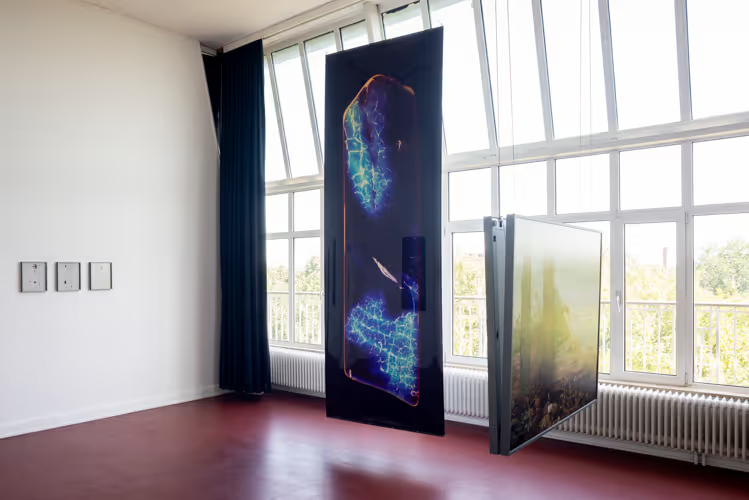
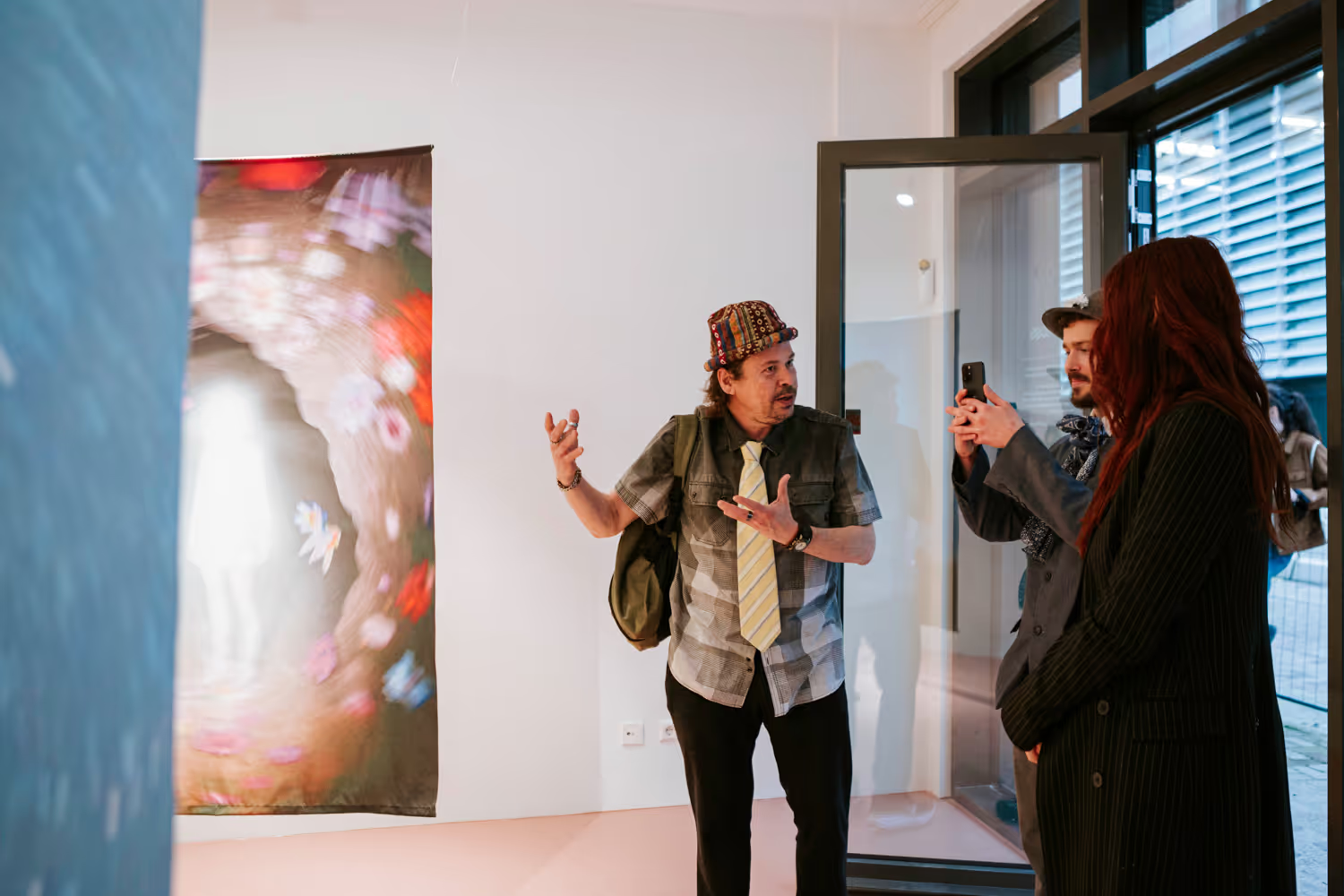
Mid-nineteenth century photography inventor William Henry Fox Talbot talked about 'the pencil of nature' when describing the magical images he fixed on paper, as if photography was inviting natural phenomena to just impress themselves on light-sensitive plates, that by way of human's chemical inventiveness could be preserved and passed on down the generations. Casagrande taps into that pioneering energy of the likes of Talbot and Anna Atkins, while also being firmly rooted in the present, with its digital proliferation as well as ecological and climatical crises. Her work focuses on various non-human life forms, co-inhabitants of the urban environment, photographically magnifying them and picturing them by using plant-based developers. Different traces of the image-making process are left visible, as a gentle reminder that life means symbiosis—no being can do without other beings, whether internally or externally. There is no such thing as purity, according to Casagrande. This conversation is based on two meetings I've had with her in Amsterdam, one studio visit and a public Q&A during the Open Studio on 1 July 2026, in which the work on display functioned as a conversation starter and catalyst for the (re)generation of knowledge and ideas worth spreading.


Taco Hidde Bakker (THB): On the surface your work seems to be about beings like caterpillars, moths or birds, while also leaving visible certain traces of the photographic and reproduction technologies you employ. The images betray sustained attention, to what has been observed as well as process, and on the surface have a pleasing aesthetic effect on me. Yet they also hint at unspoken depths. What are the motivations and interests underlying your artistic practice?
Benedetta Casagrande (BG): I am a biophile, and today as a species we are experiencing a great degree of loss; not only the loss of life happening through extinctions, but a significant loss of knowledge and understanding of other species and of the Earth systems we are embedded in. I see the slow and prolonged observation of more-than-human life prompted by the photographic process as a way to restore lost knowledge and rebuild relationships. Species are co-constituted in inextricable ways: we share an ancient biological kinship with all living forms and whatever the future may hold for us, we are moving towards shared destinies. The joy and marvel in getting to know the multitudes of brilliantly intelligent ways life thrives on Earth, and the joy of knowing we are part of this family, is definitely a driving force in my creative practice.
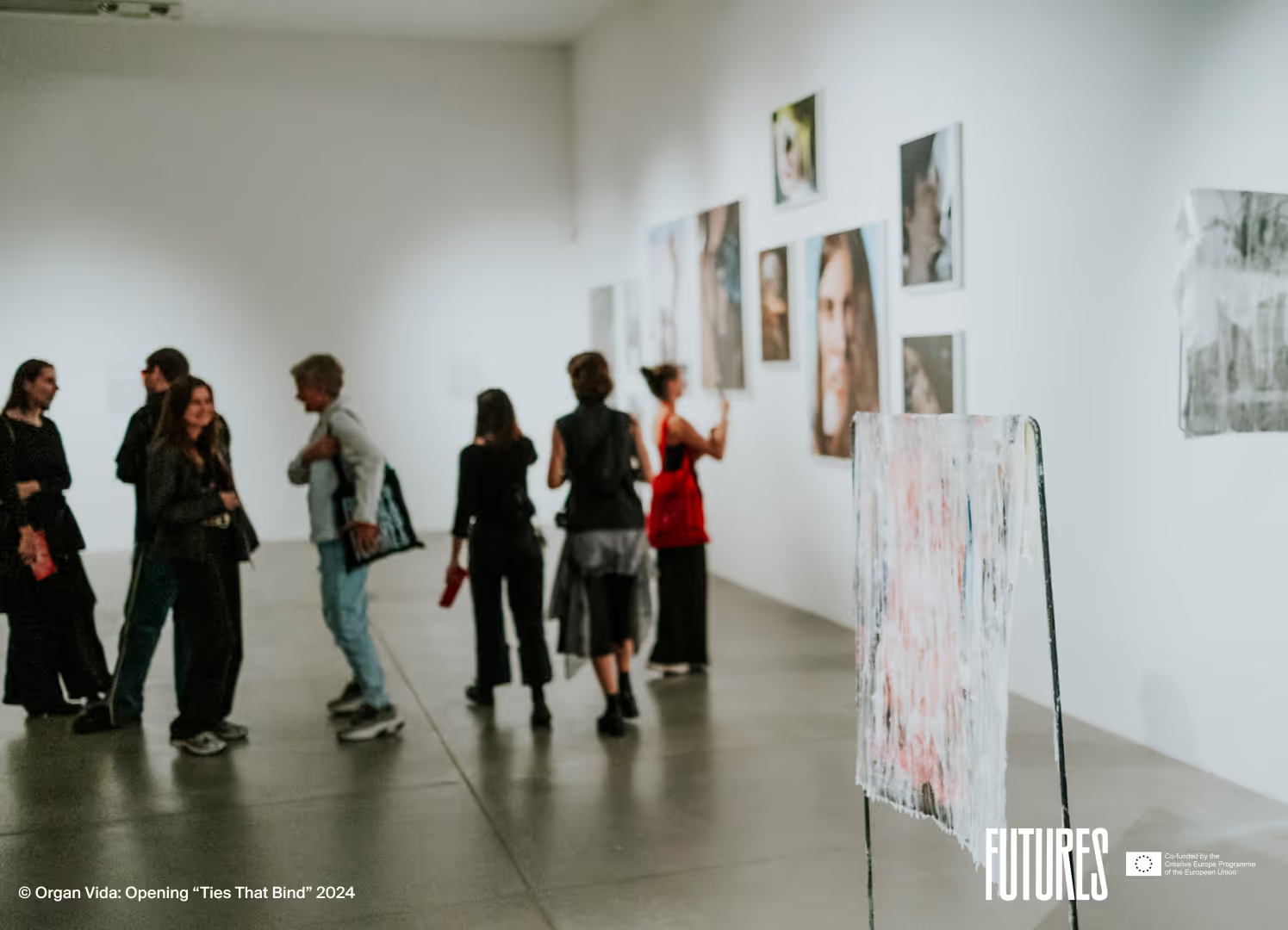
To me practicing art is akin to practicing life, and I am slowly attempting to build an art practice that intersects with and actively sustains practices that take care of the land and of the biosphere, working towards shared health, rooted in relationships based on principles of reciprocity. Practicing is very much a way for me to learn how to inhabit this world. From the teachings of Hannah Fletcher and The Sustainable Darkroom I learnt to think about 'impact' not only as something negative that must be reduced, but as behavior that could potentially affect the places we inhabit in ways that are positive, also through the spoils of art practices. I loved how our public conversation during the Open Studio at the Futures Hub ended on the note that art teaching could result in giving students the tools to learn how to tend to the land and grow a garden.
THB: The Sustainable Darkroom and other initiatives working on detoxifying (analog) photography are great. Inspired by their work you are developing your own plant-based methods. Could you describe some of the most important technical details of your special photographic processes, from photographing to developing and fixing?
BG: At the moment I am in a learning-and-adjustment phase in which I am shifting my practice so to permanently integrate everything I learnt from the Sustainable Darkroom, from Curioso Lab, and from my own experience over the years. I would not say that I am developing my own methods per se, at least not in terms of recipes or research into new materials. But the whole process currently goes something like this: looking -> relating -> consent? -> photographing -> selecting -> printing at home with a lo-fi inkjet printer -> rephotographing on film -> scouting the territory to discover plant species and assess which ones could be appropriate allies to make developer with (are they abundant? how often do they occur? etc.) -> forage -> make developer & other chemistry -> print -> dry -> and if printed on a grid: assemble the parts (finally, the image appears in full!). And finally: degrade chemical waste (takes a few months, depending on the season) -> compost -> return to land. I usually buy silver gelatin paper second-hand (opened/expired/leftovers, etc).
THB: I love that you pay close attention to animals wherever you work (among others at the botanical gardens in Amsterdam during your residency there) and that you involve plants around in the process of imaging. There's no direct visible link between image and referent, but there is ecological embeddedness. It's interesting, too, that digital machinery is still in the loop. During my studio visit we've talked about the need for roots, and attachment to place (how to re-indigenize ourselves), but that nowadays it comes with a global mindset. What does it mean to be rooted or uprooted? Is uprootedness the condition for most urbanites? What are the consequences of being detached from ecological realities for one's practices, both in life and art? When artists address issues related to global heating, biodiversity loss, solastalgia and so on, I think the issue of rootedness/attachment to place (topophilia) is key. In what ways does your practice relate to tensions between, on one hand, the global/general and the local/specific on the other?
BG: Whilst I do not necessarily use the same plants I photograph to make the developer, I wouldn’t say that there is no direct link between image and referent. I think the material link between body, sunlight and photosensitive surface is a direct link, with light being an active agent that threads together image and referent. The pencil of nature, right? This touching, direct material connection and simultaneous transformation of reality is maybe the main thing that made me fall in love with photography in the first place. But moving on to questions of the local and global, these are questions I have been thinking about a lot, but don't feel like I have actual answers to. Knowing the land, knowing its inhabitants, learning how to take care of them properly, building rooted relationships and deep knowledge... all of this takes time. It means years of observation, interaction, communication, commitment towards one plot of land, whether big or small, urban or rural, and all the living and nonliving things that live upon it and underneath it. It means going back to the same places and getting to know them intimately. My aim in time is to build an art practice that works in synergy with the territory and the passing of the seasons; certain processes take time and require long-term care (e.g. degrading the chemical waste, growing a garden, etc), and these practices are spontaneously rooted in place. It's interesting that you mentioned attachment to place, which reminded me of one of the opening chapters in Deborah Bird Rose's book Wild Dog Dreaming, about building ethical relationships with nonhuman others in our era of mass extinction. Conservation biologist Michael Soulé said that people save what they love, while Wallace Stegner said that we can love a place and still be a threat to it. Rose takes these two statements as her starting point to reflect on the need to ask new questions about love in an age of extinction. She asks important questions, such as: Who are we as a species? How do we fit into the Earth system? What kind of ethics do we need? How can we find a path toward new narratives that will guide us through an era of profound change? How can we reinvigorate love and action in ways that are generous, mindful, and life-affirming? In addressing these questions, Rose draws on the teachings of the Indigenous peoples of Northern Australia, particularly the Yarralin and Lingara communities, whose culture is rooted in a close interspecies kinship with plants and animals.
We are living through global crises which in many ways require local solutions, so there is this interesting relationship between the local and the global, and I believe many solutions are being carved out by collective action, both locally and across geographical borders. Also in the field of photography and image-making, Curioso Lab and the Sustainable Darkroom work in ways which are rooted yet they are both committed to collectivizing ecological practices across borders, sharing knowledge and know-how so that more and more people can participate and expand these movements, integrating sustainable thinking within their practice and everyday life. It is important for knowledge and ideas to travel and to learn from each other's localized experiences (this is very true also with social movements), and adapt and reshape them based on local specificities.
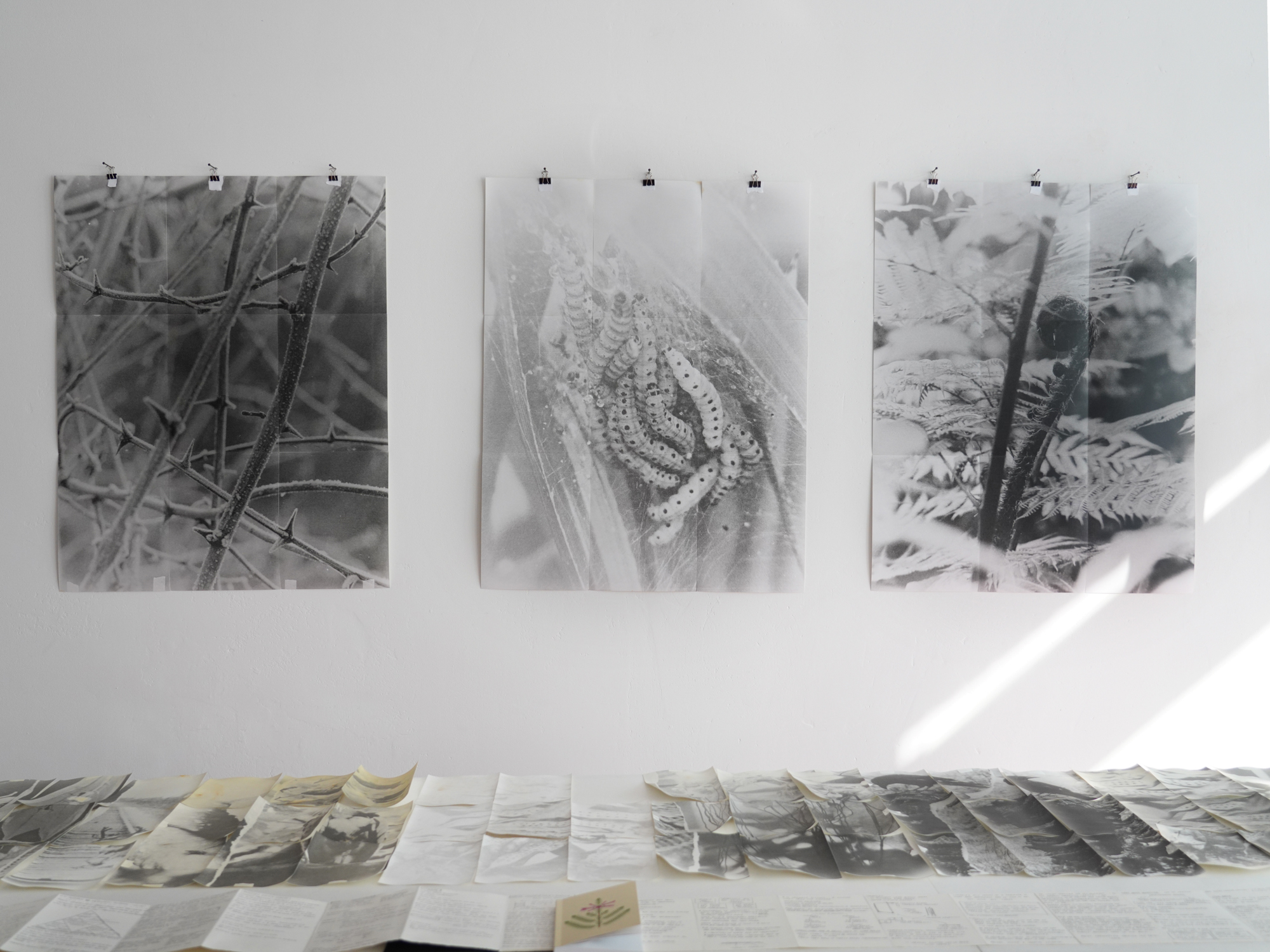
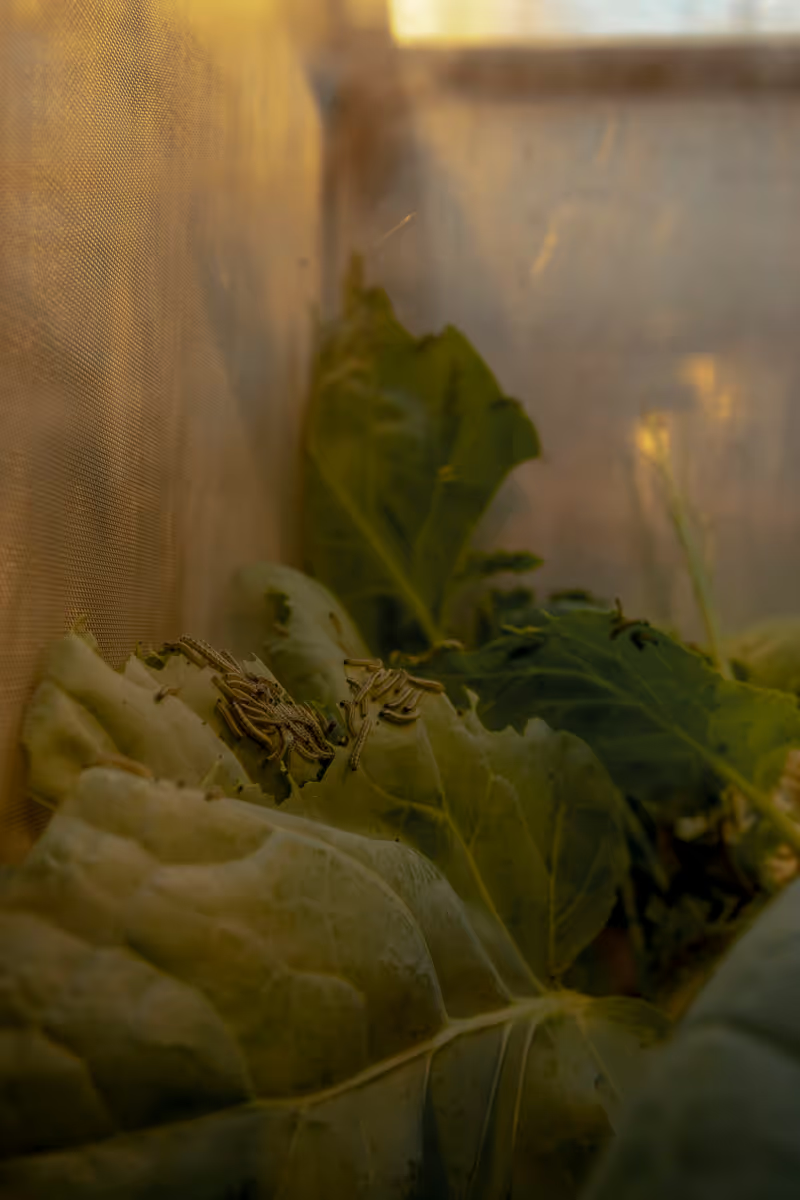
Currently these tensions emerge within my practice through the narration—both visual and verbal—of situated encounters that oftentimes result from interspecies dramas happening against the backdrop of a world undergoing a severe loss of life. These encounters are totally mundane, spanning from joyful happenstance encounters with new species, like the caterpillars of the spindle ermine moth in Amsterdam, to relationships that are complicated by hardship and interspecies care, such as the rat pups my husband and I nursed into adulthood last year, after they lost their mother and were rejected by local wildlife rehabilitation centers for being considered 'pests'. I would like my project ‘Recollections’ to be able to hold it all, without leaving out one thing or another: the joy, the grief, the injustice, the love, the curiosity, the anger.
THB: You've told me about the 'sheer joy' you feel for the multitude of forms of intelligence to be found among life on Earth. Could you describe how that translates into your work? Does it inspire you to experiment with certain techniques or methods, or does it rather direct your focus to depict (or collaborate with) certain non-human lifeforms such as caterpillars, moths and birds?
BG: There is something so joyfully world-expanding about moving beyond human affairs and allowing oneself to focus on and familiarize with the affairs and cultures of other species. They provide other ways of accessing the world. In a way, I think this is exactly what photography can do: it provides new points of access and extends the ways we look at and understand the world. I have found myself particularly enjoying changing the scale of things, particularly enlarging small critters and plants. And enlargement in size tends to go hand in hand with a dilation of time, too… with slowness. During the residency in Amsterdam I have been reading The River of Consciousness by neuroscientist Oliver Sacks, and I stumbled on a great passage in which he talks about the relationship between speed and scale, thinking about "slow motion as an enlargement, a microscopy of time, and speeded-up motion as foreshortening, a telescopy of time." In the slowed dilation of enlarged images of more-than-human bodies I feel myself pulled closer to the inaccessible 'secret' of the ways in which other species experience the world. The philosophical school of Object-Oriented Ontology (OOO), as formulated by Graham Harman, suggests that nothing can be accessed all at once in its entirety, and that there is no 'top' access mode to get at what a thing really is. In Timothy Morton's words, "OOO offers us a marvelous world of shadows and hidden corners [...] in which things can't ever be completely irradiated by the ultraviolet light of thought." In OOO a human thinking about an apple and a worm tunneling into it both provide equally valid (and equally incomplete) data and information about the apple. How humbling is that?! Photography, like the other arts, does this for me, as well as poetry: it brings me closer to that terrifying vertigo happening when you realize the smallness and the limitedness of our experience of the world. But getting back to your question, it's hard for me at this stage to describe how my attention is being directed by the things I encounter in the world, and how they translate into my work, as it is very much a matter of being situated in place and taking the time to observe who is around, and give them my attention whether they be bugs, birds, bees or trees. It is the mundane space of our bodies and our environment that calls to me, I am never on the lookout for something particularly 'out of the ordinary', as life on Earth is already pretty exceptional and weird on its own. I guess that this is one of the things I hope radiates through my work: the weirdness and amazement of life and the de-centering of human exceptionalism.
THB: Above you already raised the question of 'how to co-constitute'? How would you describe co-constitution and what does it mean in the context of your work? I'm also curious how this relates to the role of contamination. You purposefully show your work in a 'contaminated' form by allowing darkroom and other production 'mistakes' to remain visible, which adds to the liveliness of the work, as if nature including chemical and other processes is indeed co-author to the work.
BG: There is one passage in When Species Meet by Donna Haraway that I particularly love and hold close: “I love the fact that human genomes can be found in only about 10 percent of all the cells that occupy the mundane space I call my body; the other 90 percent of the cells are filled with genomes of bacteria, fungi, protists, and such, some of which play a symphony necessary to my being alive at all, and some of which are hitching a ride and doing the rest of me, of us, no harm. I am vastly outnumbered by my tiny companions; better put, I become an adult human being in company with these tiny messmates. To be one is always to become with many.” This is what it means to be co-constituted. It's not a matter of 'how'; being co-constituted with multitudes of other species and life forms is a biological imperative and an inevitable fact of life. For our bodies to be alive at all we are born 'contaminated', there is no original purity to return to.
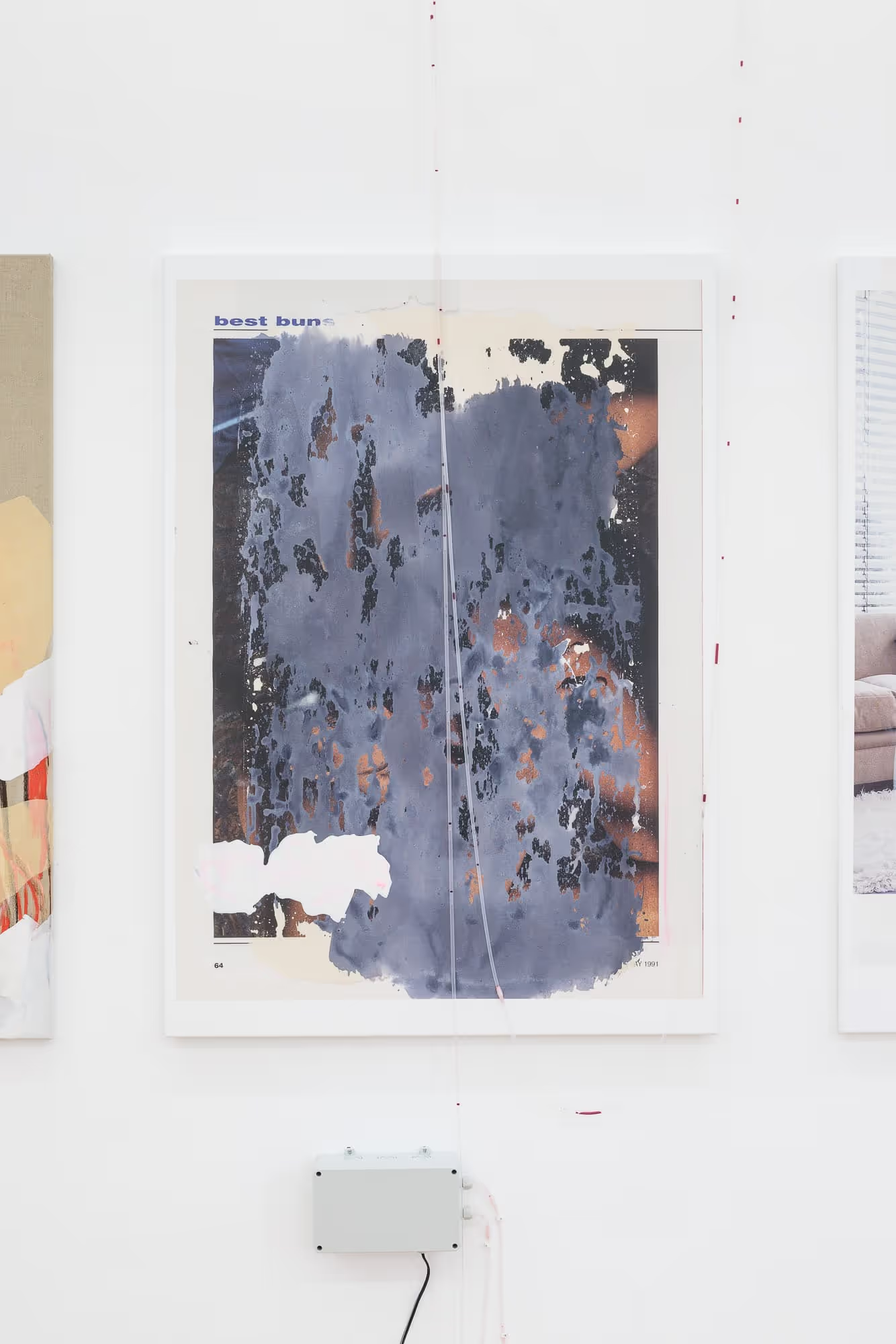
Working with plant-based developers, the chemical instabilities and contaminations become evident in ways I cannot predict or control, as they vary depending on the different types of paper, on the plants who partook in the development, on the temperature changes within the darkroom, on how active or exhausted the developer is, on fluctuating development times. So there is an interest in giving up, or at least loosening, my individual agency and authority. In this sense the images produced are the result of a collective effort, between animate and inanimate things, and the environment they sit in. The image is then further 'degraded' and made 'digitally contaminated' by passing from the lo-fi inkjet printer before being turned into a silver-gelatin negative. All these different forms of materialities, from plants to ascorbic acid to silver to animal-based gelatin to paper fibers to the many singular electronic components of a digital home printer: these technologies embody specific material histories that converge and bring the image-object to us, today, right now, whether we are seeing it on the screen or as a print in an exhibition. I want all of these traces and material interdependencies to become visible on the photographic surface. I guess we can also safely say that by now we are co-constituted not only with other life forms, but with many inanimate agents too, which penetrate our porous skin and affect our biologies. In general, they impact and change our lively world at large.
Tips for further reading and learning
Deborah Bird Rose, Wild Dog Dreaming (University of Virginia Press, 2011)
Robin Wall Kimmerer, The Serviceberry (Scribner, 2024) and The Democracy of Species (Penguin, 2021)
Alexis Shotwell, Against Purity: Living Ethically in Compromised Times (University of Minnesota Press, 2016)
Timothy Morton, Being Ecological (Pelican, 2018)
Donna J. Haraway, When Species Meet (University of Minnesota Press, 2007)
Oliver Sacks, The River of Consciousness (Knopf, 2017)
With a Bird, A Reader on Avian Kinship (Onomatopee, 2025)
On lower-toxicity* photographic techniques:
The Sustainable Darkroom: https://sustainabledarkroom.com/
Curioso Lab: https://curiosolab.thinkific.com/
* While the toxicity is incredibly lower, it is important to refrain from calling the chemistry non-toxic, as it could be misleading to some and also result in improper waste management.
.jpg)
.jpg)
.avif)



.avif)

%2520Unseen-campaign-2024-square-forweb.jpeg)

.avif)


.avif)





.avif)




.jpeg)




.jpg)
.jpg)







%252C%25202015.jpeg)