The FUTURES
Residency Program
The FUTURES Residency Program provides emerging artists with time, space, and resources to develop new work, emphasizing artistic process and research, while offering opportunities to push the boundaries of their practice and engage with contemporary themes.

residency theme
how it works
program
At the beginning of 2025, FUTURES introduced a Research Residency Program across three locations: FUTURES Hub in Amsterdam, Capa Center in Budapest, and ISSP in Riga. Selected from a pool of nominated FUTURES artists, participants are chosen by a diverse panel of experts. Open to all artists nominated in previous years, the program aims to foster production, exchange, and meaningful artistic growth. Applicants are evaluated based on their artistic practice and the quality and relevance of a residency project developed specifically for their time with FUTURES.
- Professional Mentorship: Residents receive tailored mentorship from experts relevant to their project, offering guidance and support throughout the residency.
- Public Engagement and International Exposure: Each residency concludes with a public event, and the artist's work is promoted through communication channels of FUTURES.
- Fair and Inclusive Working Environment: The residency ensures fair pay, safe working conditions, and a commitment to inclusivity.
- Access to the FUTURES local network and introduction to Amsterdam art and contemporary culture scene.
from the residents
- Residents are encouraged to maintain a Visual Diary, posting weekly updates about their creative process on FUTURES’ social platforms. This offers an inside look at the artist’s journey.
- A Video Portrait is created during the residency, offering a personal insight into the artist and their practice. This video is shared through FUTURES’ platforms, extending its reach.
- A public-facing event, such as an open studio, workshop, exhibition or artist talk, is an essential component. This event offers residents a chance to share their work and process with the local community. This will also be live-streamed, allowing international audiences to engage with the residency's work.
- Interview with a local writer about the artist's creative process during their residency. This written interview will be featured on the FUTURES website, offering further insight into their work and artistic journey.
residency locations
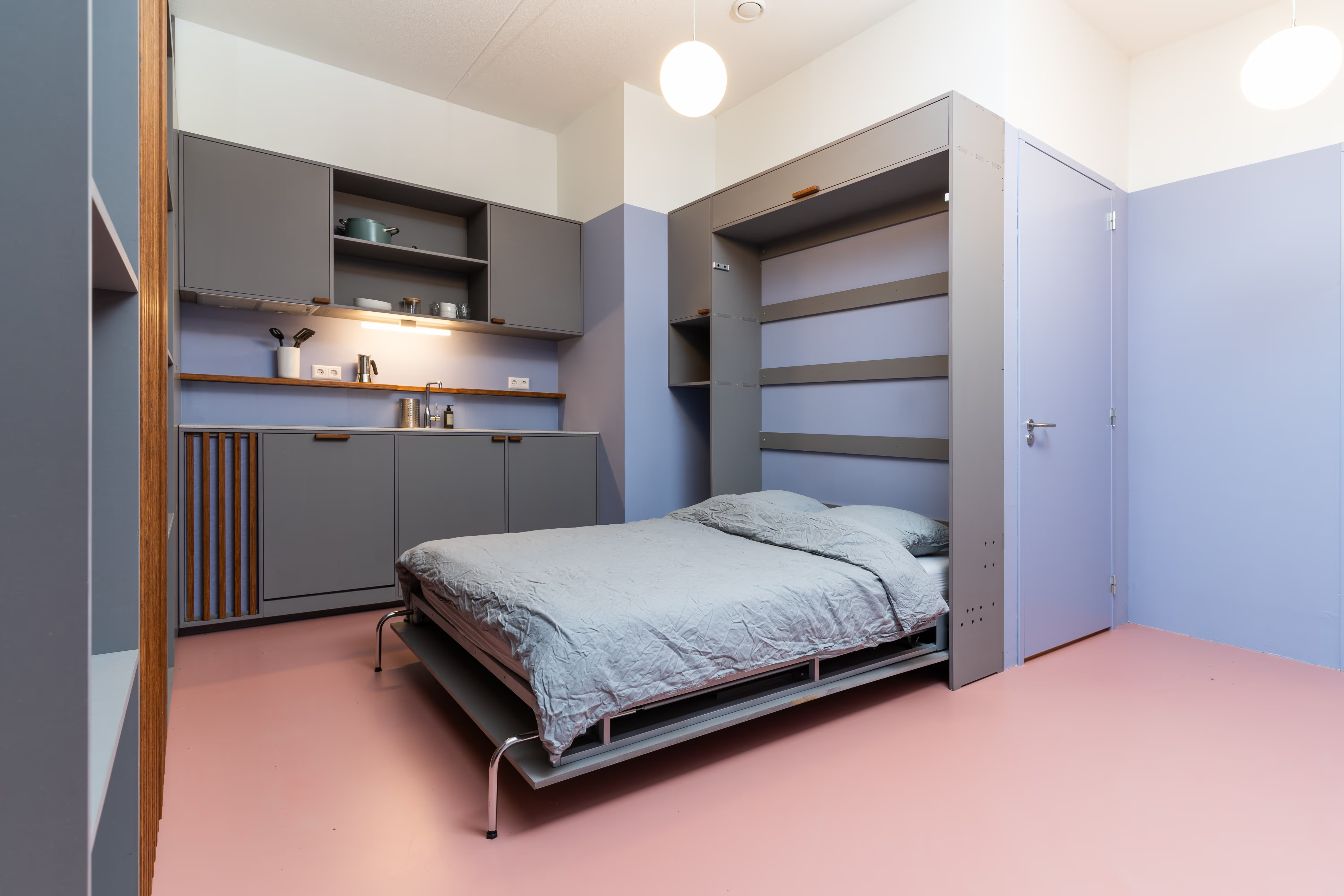
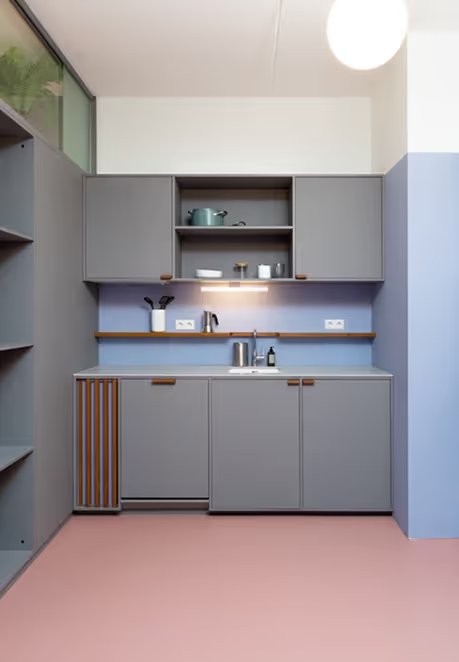
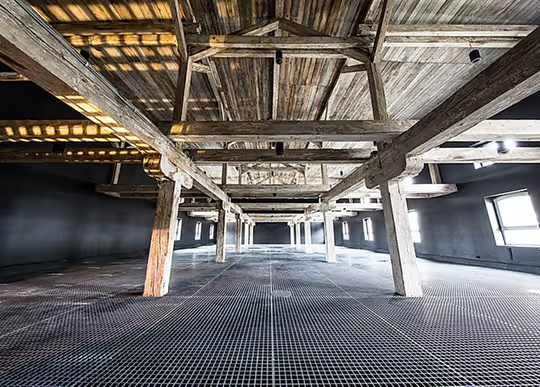
Futures Hub, Amsterdam: In 2023, FUTURES launched its first residency program at the FUTURES Hub, a vibrant space in Amsterdam that serves as the platform’s global headquarters and flexible exhibition venue. Situated on a former industrial site, the Hub offers a fully equipped live-work environment, including an atelier, furnished apartment, and event space. It welcomes artists from diverse regions and cultural backgrounds for both short- and long-term stays.
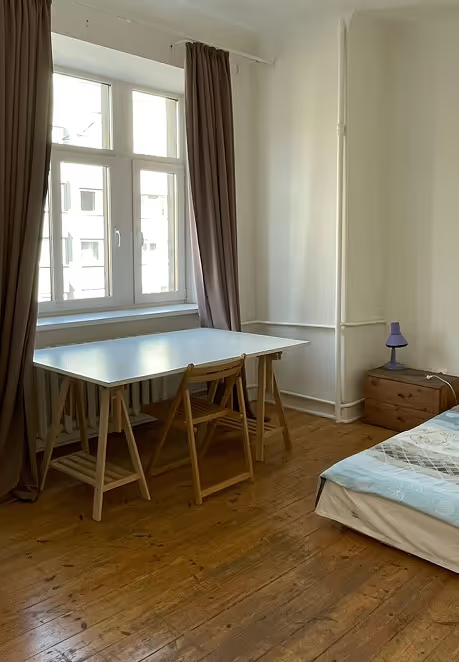
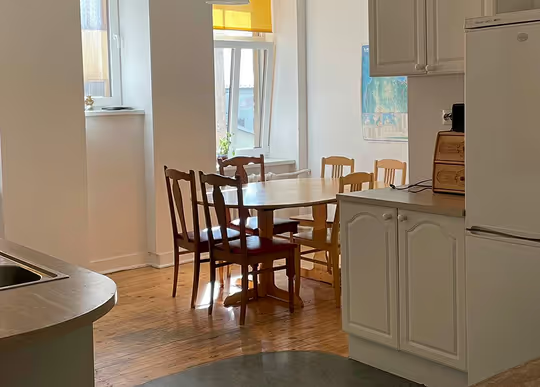
ISSP, Riga: The resident will be housed at the ISSP Riga Residency apartment in the city centre, shared with other two artists. The accommodation offers comfortable conditions for living and working - a separate bedroom with a working space, spacious shared living room and a fully equipped kitchen. The resident will have access to ISSP office facilities including use of printer, scanner, ISSP photography library and studio lights.
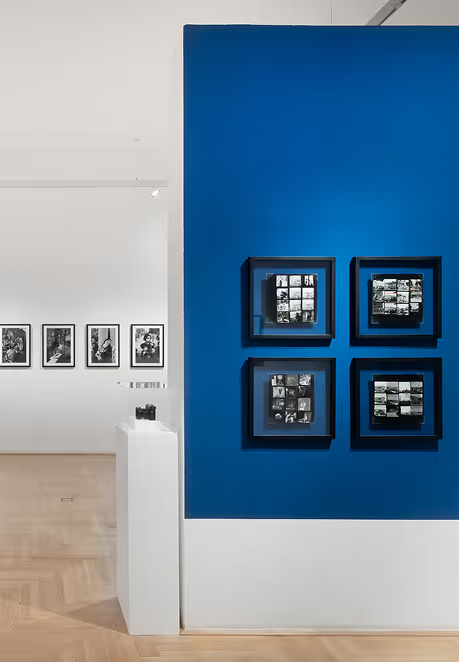
Capa Center, Budapest: The Capa Center residency program offers all entering participants a fully furnished private room within a communal apartment located on the Art Quarter Budapest premises, a studio space catering to the project’s requirements within its 400 m2 shared studio in the coolest postindustrial area of Budapest. Capa Center provides varied services to integrate the residents into the local art scene and contribute in establishing professional connections that best support their work and career. In addition, the residency will offer the possibility to organise a presentation at the Capa Centre in downtown Budapest, and use the Capa Centre's office facilities, including the printer and scanner.
Residency Archive
Her research revolves around ecology, new technologies and the construction of post-capitalocene imaginaries. She was an artist-in-residence at Villa Pérochon under the mentorship of Joan Fontcuberta. In 2025, she began a residency in regenerative design at Fondation Martell. Her work has been presented internationally in numerous festivals, galleries, and museums like Paris Photo, Rencontres d’Arles and Photo Élysée.
In 2024, she was invited by Sigma to present a large-scale exhibition combining multiple projects in Aranya and Shanghai. In 2027, she will present a solo exhibition at the Braunschweig Museum für Photographie. Supported by Fondation des Artistes for her project Tigre jaune sur fond bleu (2025), Azzopardi has received several awards and grants, including the CNAP support for contemporary documentary photography (2025).
Her first book, Non Technological Devices, will be published by Witty Books in 2026.
Her interest lies on connections between body, soul and spirit. She focuses on social and psychological issues, their brutality and beauty, which she represents through an ethereal and intimate atmosphere.
She obtained a master’s degree in Photography at Moholy-Nagy University of Art and Design in 2016. In 2013, she spent a semester in Brussels with Erasmus, later, she completed her mandatory internship in Paris with Erasmus+.
In 2013 she was selected to the top 100 of Google Photography Prize. In 2014 she won a grant to organise her first solo exhibition titled Bleu, which took place at Gallery Várfok Project Room, Budapest. In 2015 her series Animalia Variabilis was shortlisted at the 5th World Biennal of Student Photography, Novi Sad.
In recent years, her photos gained exposure in various places including the Ludwig Museum of Contemporary Art Budapest, the Mai Manó House, the Vienna Photobook Festival, the Berlin Photobook Festival, the Mark Grosset Prize, Vendôme, the Kiscell Museum , and the Robert Capa Contemporary Photography Center and der Grief magazine.
She is a member since 2012, and a board member since 2020, of the Studio of Young Photographers. She lives and works in Budapest, Hungary.
Julie Glassberg was born and raised in Paris, France. After studying graphic design for four years, she decided to make her passion for photography become her life and moved to NY. Her interests are primarily based on the diversity of world cultures, subcultures, underground scenes as well as the misfits of society. Photography is like a passport to enter worlds that she would never be able to see otherwise.
She regularly collaborates with The New York Times, and from late 2011 to 2015, the Metropolitan section of the paper assigns her, with staff reporter Corey Kilgannon, to photograph the portraits of the weekly column Character Study.
After spending close to 7 years in New York City, she lived in Tokyo, Japan for a year, where she met local artists and experimented more with photography and collaborations. She recently completed a 6 months residency program in Shanghai at the Swatch Art Peace Hotel and lives in Paris at the moment.
Her work has appeared in publications such as The New York Times, The New York Times Magazine, Le Monde, The International NYT, El País Semanal, ESPN mag, Neon mag, Stern View, L'Equipe mag, Polka, among others.
She has been awarded a Lucie Scholarship Emerging Grant, a Getty Images Grant for Editorial Photography, a POYi Award of Excellence, an Art Directors Club Young Gun award, an IPA award and her first book was recently shortlisted by Paris Photo / Aperture.
Visual and sound artist based in Łódź (Poland). In his artistic work, he uses photography, sound, video, installation. His exhibitions are site-specific.
His artistic work is closely related to the technological workshop, experimentation and the search for suitable means of expression to communicate content. He is interested in the interpenetration of the fields of art, where sound, image and space can provoke impulses through which intuition complements logical thinking – where the exposure to a work of art builds the experience of art.
Bartłomiej Talaga is a graduate of and teacher at the Film School in Łódź. In his work, he shares his own experience with students and focuses on the purposefulness and legitimacy of gestures that lead to personal and authentic expression. He is also a co-founder of the TON magazine (ton-mag.pl) and a designer of photography books.
Inspired by comics, cinema, and Brazilian (post)modernism, his work moves fluidly across formats, from artist books to exhibitions and multimedia projects. He holds a Master’s in Photography and Society from the Royal Academy of Art, The Hague, where he teaches artist bookmaking and visual storytelling and mentors emerging practitioners.
His work has been exhibited internationally, including at the Netherlands Fotomuseum, Noorderlicht International Photo Festival, PhMuseum Days, Les Rencontres de la Photographie d’Arles, Encontros da Imagem, and Schwules Museum Berlin. His photobook Tropical Trauma Misery Tour received the 1st Prize at the Kassel Dummy Award ’23 (GER), the Imaginária Festival Dummy Awards ’23 (BR), and a Special Mention at the Hong Kong Photobook Festival ’23.
Portrait of Rafael Roncato by Gita Cooper van Ingen
Tim Rod is a Swiss artist based in Bern, Switzerland. He studied art education at HKB – Bern University of Applied Sciences (BA, 2018), art history at Bern University (Minor, 2019), photography at Vevey School of Photography (CEPV, ES diploma, 2021) and is currently pursuing a master’s degree in Contemporary Arts Practice at HKB – Bern University of Applied Sciences.
His work often explores issues related to exile and habitat, rootlessness and rootedness, as well as memory, identity, belonging and travelling. His own roots and family history are one of the central elements of his practice and his research, alongside collective visual culture. While his practice remains strongly rooted in photography, his works often expand into site-specific multimedia installations. His work has been exhibited since 2018 in Switzerland and internationally since 2021. Recent exhibitions include "L’Été sans fin" (Festival Images, Vevey, 2020), "Genesis" (Hackney Downs Studios, London, 2021), Charta Bookfestival (Rome, 2021), Photobook Award Encontros Da Imagem (Braga, Portugal, 2021), and the European Photobook Month (Hongkong, 2022). He has been nominated or shortlisted to several major Swiss and international awards. His project "Don’t forget the Knifish" was awarded the special mention of the near.prize 2021. The same year, he won the vfg Young Talent Award for Photography with the project "À demain inshallah".
Giaime Meloni is a visual researcher with a PhD in Architecture, currently living between two islands: Île-de-France and Sardinia. The aim of his work is to explore the role of the photography as a sensible instrument to narrate the space complexity. His researches has been published in various publications (MAM Saint Etienne, INTRU). In 2017, he was shortlisted for Premio Graziadei with his long-term project Das Unheimiliche. He teaches photography as an instrument of the making of the architectural design between France and Italy.
My practice is conceived as an act capable of questioning the nature of places.
The images provide a tangible proof of my presence in the territory, in a certain way they documented it. However I would like to take distance compared to the documentation – and strictly documentary photography – in order to provide a more universal reflection on our relationship with the space.
The photographic action that I develop aims to questioning the restitution of ordinary space in search of a visual and spatial connection with the subject. The specific interest of this practice is to investigate, by theory and practice, the photographic instantaneity and the message that it carries.
The paradox of images is that they pretends to reproduce things which are only themselves. But this is only an illusion, a conviction that is a part of the magic contemplation. In fact, during the act of photographing, I realize that things denying their existence by the image.
What it remains frozen into the fragments is the (artificial) reflection of reality as an intention of my gaze.
Every photos prove that there is an implicit message exceeding the limits of the image itself. I accept that the message of the images can be corrupted / destroyed at any time by the viewer / reader.
Laure Cottin Stefanelli is a french visual artist and a filmmaker. Through her films, photographs and installations, she pursues a research around stories focused on characters inhabited by paradoxical tensions – life, death and erotic impulses – those resulting from the separation between mind and body.
Her work had been exhibited and screened at venues including États Généraux du Film Documentaire (Lussas, FR); KANAL – Centre Pompidou (Brussels, BE); Belo Horizonte International Short Film Festival (BR); Kasseler Dok Festival (Kassel, DE); Moscow Biennal (RU); Art Brussels (BE); FIDMarseille (FR) among others. Her first medium-length film 'No blood in my body' received the short film prize at Écrans Documentaires d’Arceuil (FR). Laure Cottin Stefanelli studied literature and cinema at the University of Paris III and graduated in Photo-Video from École des Arts Décoratifs de Paris.
"A strange pleasure emanates from Laure Cottin Stefanelli’s images, a pleasure that stems from the interruption of systems, the suspension of discipline. The characters she portrays often engage in the strictures of self-imposed rigour – marriage, high-level sports, addiction, erotic role play – and her camera emboldens them in their carefully planned choreographies. Not that these choreographies become, as a result, deconstructed or “unmasked”; rather she balances the individuals between desire and ritualised gesture, arresting them in seemingly affective fulfilment. Cottin Stefanelli leaves unsaid what lies outside the frame, where conventions and rules govern the protagonists’ behaviours (...). What remains in the frame, cropped out of context, ends up looking solitary, but also confident – one dares say beautiful. (...)" Antony Hudek on Centauresse
Hanane El Ouardani (NL, b. 1994) lives and works in Amsterdam, where she graduated from The Hague’s Royal Academy of Art in 2018. The Dutch-Moroccan photographer was born in the Netherlands with bicultural roots, and her practice reflects a recurring duality: on one hand, an unwavering desire to truly feel at home somewhere, and on the other, embracing her status as an ‘outsider’ due to the unique perspective it offers her, allowing her to keenly observe differences from a distance. In 2018, she published the photo book ‘The Skies are Blue, The Walls are Red’, a visual diary that explores the various layers of a diasporic identity. The book raises questions about representing one’s roots without feeling estranged from one’s own culture.
Drawing inspiration from clichés and contradictions, her work raises questions about identity, exotism, contradictions and social status. She dissects the layers of these themes, often starting from a personal narrative, which organically speaks to a collective spanning different cultures.
El Ouardani takes her camera to places where men are prominent in public spaces. As she actively interacts with them as subjects, she insists, “ I believe it’s crucial for the female gaze to participate in uncovering masculinity’s place in our contemporary world.” Her work has been exhibited at notable venues, including the Van Gogh Museum, Unseen Amsterdam, Foto Tallinn and Paris Photo.
Sebastian Koudijzer (b. 1993) studied at the Royal Academy of Art in The Hague, the Netherlands. Growing up as a child of different races – and surrounded by a large extended family on his Javanese side – he is interested in how identities are created. Using various techniques, he creates intimate stories that address themes of family, faith, identity, and their representations. Collaboration plays an important role in his projects; Koudijzer likes to give those he photographs space for their own voice. His work is an attempt to bring disappearing traditions, values and spirituality back into his own reality, with the camera becoming an exploratory tool.
Anna Gajewszky (1997, Budapest) is a photographer based in Budapest. She has recently graduated from the photography masterclass of Moholy-Nagy University of Arts and Design.
Her work is mainly characterized by its intimate exploration of personal issues, with a focus on the intricate quality of human relationships. She examines connections people form with each other, their families, their past, their own bodies, animals, and within a larger aspect the land.
The use of self portraits underline that her work is rooted in her personal life, however the images transcend personal narrative to engage with broader themes such as womanhood, family connections, generations, and countryside, rural customs, rituals. Her images are mostly staged but they often stay on the ground of reality creating a duality of fiction and truth that is central to her projects. This approach allows her to explore and communicate complex aspects of human experience.
Her work was exhibited both in Budapest and internationally, she was published in the 2021 edition of Blurring the Lines, she received the National Higher Education Excellence scholarship, her book was shown at Polycopies 2023, she was finalist at the Paris Photo Carte Blanche Students, she was an exhibitor at the 2024 Breda Photo Festival and was presented at UNSEEN Amsterdam, by Tobe Gallery in 2024 fall.
Lorenzo Pingitore was born in Torino in 1985, he attends the Art Institute Felice Faccio, where he explores his passion for the great artists. He continues his studies in the Politecnico of Turin, graduating in "Scienza dell'Architettura e dell'Ingegneria Edile".
Lorenzo uses the photography as a way of expression; he refines his technique during a long collaboration in the backstages for several fashion brands, a collaboration that still exists.
The skills acquired will allow Lorenzo to express himself creatively.
Through the use of a camera he captures images that evoke emotions and thoughts; he is not a lover of photographic manipulation through programs, in fact he creates installations to recreate what he thought and felt while visiting those places.
Born in 1987 in Russia, Olga is a multimedia artist creating her projects in Uzbekistan, her mother’s homeland. She graduated from Moscow Industrial Art Institute in 2013. In her works Olga uses a variety of media - from subject art, installations, and performance to social research and cinema. She addresses the topic of her female genealogy: both her grandmother and mother came from Uzbekistan. Olga treats this country as a timeless space, a portal where she finds answers to questions.
In her first projects she started from classic art forms - subject art, performances and photographs, and applied mixed media method in her current project Mirage - installation, social research, movie technics. This is a social research project about the Aral Sea disaster and the people living in it‘s aftermath. The starting point was the idea to suggest the locals in the town of Muynak, a former seaport, sharing one ceramic plate and laying out a mirage on the bottom of the dried Aral Sea near the town. The results of which were expressed in an installation on the bottom of the extinct sea and a full-lengthy film Olga created while working on the project. Also working in this vein, by her own, she explores female artist possibilities in a contemporary traditional society.
“My work is a path from small forms to large ones, from serious mental practice to an intuitive and free play method. My life has become an indispensable part of this conscious philosophical method. Last project Mirage can serve as an illustration of this approach. Here I play a game in which the object turns into a tool to communicate with the whole country.”
Gulsah Ayla Bayrak (born 1997), is an interdisciplinary artist from Belgium, working on the larger themes of identity and belonging, in a complex world of interactions between her the different fragments that she embodies: Her Turkish roots and her political identity as a citizen of modern Europe, juxtaposed for the ramifications of feminist theory when thinking about the body and the self and the cultural and political consequences of queerness in an era of increasing polarization, but also of multiple polarities. Taking the migration stories in her own family as a starting point, Bayrak draws on personal biographies, to re-narrate events in such a way as to reconstruct the experience of lived time, and not merely chronologies. In her practice, moving seamlessly between Asia and Europe, both physically and emotionally, the polarity of global north versus global south emerges sharply, around the political definition of “East”—a borderland of European modernity, wholly constructed by it. The idea of the fragment resurfaces in Bayrak’s projects as a partial narrative, constitutive of our shared, social experience, and which cannot be dovetailed or manipulated, so that it remains always alive, fresh, fragile, and unfinished. In this inconclusiveness the artist finds paradox, and within paradox, the complexities of modern identities fabricated from torn off bits of different, larger structures. In dealing with objects as markers of memory, and with memories as physical objects Gulsah Ayla Bayrak creates unfinishable threads of historicity, unfolding in simultaneity, searching for a lost, but ultimately unidentifiable, temporal index.
However, the themes in my artistic practice today are still characterised by a tightly structured childhood, youth and apprenticeship: in my work, I have been exploring the concepts of collectivity and intimacy for several years. I am always looking for liberating and solidary acts in performative moments and arts production. My image- and sound-based practice reveals my great affinity for technology, the exploration of boundaries and needs in dialogue and the creation of trusting connections and learning spaces in my collaborations.
As a child of the working class, I am concerned with my own role as an artist in society and what (political) room for manoeuvre this opens up for me. The problem of self-exploitation, especially - but not only - with a body read as female, is a recurring theme in my artistic practice.
Since 2019, the Salon Vert has been a network of artists, a laboratory for sound research and a place for interdisciplinary dialogue. The Salon Vert has found a new home in my studio in Lichtensteig in 2023. I am also co-founder of the audiovisual Glitch Festival in St.Gallen and music editor at the community radio station Stadtfilter in Winterthur.
Ligia Popławska (b. 1994, Poland) is a visual artist currently based in Antwerp, Belgium. Her work explores themes of senses, emotional states and human impact on environment. With a deep interest in natural phenomena, art history and sciences, her researchbased, speculative work focuses of human and morethan- human in the changing conditions of the (Post) Anthropocene. She graduated with honours from the Photography department at the Royal Academy of Fine Arts Antwerp (BA and MA), previously gaining a BA in Art History from the University of Gdańsk (2016). Her project ‘Fading Senses’ won Decade of Change Series Award (2022) by the British Journal of Photography, as well as a solo exhibition at PhMuseum Days International Photography Festival in Bologna, Italy (2021) and Photography Prize funded by the Royal Academy of Fine Arts Antwerp (2020). Ligia Popławska is a laureate of .tiff 2022 (FOMU Antwerp) and a recipient of a scholarship for Emerging Talents from the Flemish Government. She exhibited at Bienal’23 Fotografia do Porto, FOMU Antwerp, De Brakke Grond, Helsinki Photo Festival, among others. Ligia Popławska works as a freelance photographer and editor.
Juliette Cassidy is graduated in Arts from the Massachusetts College of Art and Design in Boston. After finishing her degree, she travelled across 19 states of the USA, working on the series 'People We Know, These Americans', where she focuses on the emptiness brought by the most brutal capitalism in one of the richest countries in the world. Afterwards, she moved to Mexico City, followed by Los Angeles. She is currently based in London. Although she works in fashion, her most personal work, leans towards documentary photography, which is, at times, influenced by fashion.
She very often travels to remote places, far away from the big cities, where she is able to find more simpler ways of existence.The subjects she photographs are often isolated with little context around them. While this visual isolation is the way Juliette presents herself to the world, she also craves human connection. A direct confrontation with the camera is a way for her to connect with the subjects she photographs and through them with the rest of the world.
In a few words, her practice in documentary photography is a search of self-knowledge and an attempt to reencounter the essence of a life without noise.
Laure Winants is a researcher and field-based visual artist (BE, FR). Winants set up her artist’s studio in the heart of the Arctic ice pack. Embarked on a four-month polar expedition, she joined a team of multidisciplinary researchers to understand the evolution of this vast territory, where man is only a tiny part of life. Immersed in this white desert, she uses techniques developed specifically to capture the optical and luminous phenomena unique to the region. Using environmental sensors, the interaction of matter itself has become the creator of the work, putting human intervention to one side. Laure Winants makes this data tangible and emotionally perceptible, highlighting the interdependence of ecosystems and creating encounters in more-than-human temporalities. In this way, the artist creates a dialogue between art, the natural sciences, and technology.
Laure has exhibited her work internationally in Berlin (DE), Reykjavik (IS), Brussels (BE), Paris (FR), and soon in Stockholm (SE), Luxembourg (LU), and Osaka (JP). Her work has entered the collection of several foundations, such as the Fondation des Arts du Luxembourg and the Palais de Liège (BE).
Duchateau is an artist who mainly works with photography. By applying a wide variety of contemporary strategies. His photos are an investigation into representations of (seemingly) concrete ages. By studying sign processes, signification and communication, he makes work that generates diverse meanings, associations and meanings collide. Space becomes time and language becomes image.
His works are characterised by the use of everyday events in an atmosphere of middleclass mentality in which recognition plays an important role.
By taking daily life as subject matter while commenting on the everyday aesthetic of middle class values, he plays with the idea of the mortality of an artwork confronted with the power of a transitory appearance, which is, by being restricted in time, much more intense. His works question the conditions of appearance of an image in the context of contemporary visual culture in which images, representations and ideas normally function. He makes work that deals with the documentation of events and the question of how they can be presented.
Lars Duchateau currently lives and works in Hasselt and Ghent.
Olga Cafiero (*1982) is a Swiss and Italian photographer based in Lausanne. After a BA in photography and an MA in art direction at ECAL, she studied art history at University of Lausanne. Her work has been shown in exhibitions in Switzerland and internationally since 2008, and regularly published in international magazines since 2009. Her awards include Foam Talent (selection), Hyères Festival de Mode et de Photographie, BFF-Förderpreis (laureate), a Swiss Design Award (laureate) and L’enquête photographique Neuchâteloise (laureate).
Ksenia Ivanova is a documentary photographer based in Berlin, Germany. Her work focuses on themes of trauma, explored through long-term storytelling. She was a finalist for the Leica Oskar Barnack Award (2024) and the Picture of the Year, Online Storytelling (2021), and won the Lucie Foundation Documentary Award (2023).
Ksenia's projects have been featured in The Washington Post, Courrier International, XXI Revue, and Der Spiegel. She has also contributed to The New York Times, Zeit Online, Le Monde, Libération, and GEO France, among others.

Yu Shuk Pui Bobby (b. 1994) is a visual artist based between Hong Kong and Oslo. With a collaborative approach to her practice, her work conjures the physical, tangible and affective phenomena associated with biotechnology through combinations of video, text, installation, sculpture, and performance. She often uses speculative fiction to tackle questions of human genetic engineering, reconfiguring perceptions of gender, body and historical discourses of identity. Bobby holds a BA from Hong Kong Baptist University and an MFA from Oslo National Academy of Fine Art. Her works have been in Hong Kong, Norway, Japan, China, Iceland and the USA.
from the
residency

Ugo Woatzi was born in France, in 1991. Nominated for Futures by FOMU, he lives and works in Brussels and in Johannesburg.
Ugo Woatzi’s photographs reference real and imagined spaces caught between the worlds of freedom and constraint. He reveals and yet conceals, as a chameleon changes colour to blend in and survive. Ugo’s collaborative process is a reflection of the desires and struggles of his community. Together they create a more sensitive and accepting world, one that both escapes from and confronts the harsh realities of divisive heteronormative structures. The images, tender yet defiant, transmute feelings of love and of conflict, a relatable and universal sense of longing. His sensuous, quietly intimate gaze taps into subtler aspects of human desire — and yet these seemingly accessible emotions are simultaneously blocked in an act of obfuscation. His concealment of faces and identities evokes the fear, censorship and stifling experienced by queer communities across the globe.
Ugo invites us to consider and celebrate a range of masculinities, performative bodies, psyches, and experiences, as he explores the idea of “visibility” as one fraught with both fear and excitement. This duality is embodied powerfully in Ugo’s work, which is both a performance and a lived reality, the speaking of truths and the creating of fictions. That is the nature of photography: to create new worlds from fragments of previous ones. It is in this new world, in the sensitivity of Ugo’s gaze, that we finally access a space of acceptance.
- Text by Michelle Harris (.TIFF)


Olena Morozova is a visual artist from Kyiv, Ukraine. She is interested in themes of spirituality, sexuality, gender identity, stereotypes, psychological and mental disorder, family relationships. "Photography is my passion, lifestyle, philosophy, way of thinking, seeing, understanding the world around me and my inner world, searching for my reflections, feelings and emotions, self-development and movement forward” - she explains. Olena has been engaged in photography since 2015. Her teachers were: Alexander Yakimchuk, Dimitri Bogachuk, Vladimir Seleznev, Viktoria Sorochinski, Sergey Melnichenko and others. Her works were presented in Finnish Museum of Photography (2022), Odesa Photo Days (2021), Photo Kiev Fair (2019, 2020).
Yu Shuk Pui Bobby (b. 1994) is a visual artist based between Hong Kong and Oslo. With a collaborative approach to her practice, her work conjures the physical, tangible and affective phenomena associated with biotechnology through combinations of video, text, installation, sculpture, and performance. She often uses speculative fiction to tackle questions of human genetic engineering, reconfiguring perceptions of gender, body and historical discourses of identity. Bobby holds a BA from Hong Kong Baptist University and an MFA from Oslo National Academy of Fine Art. Her works have been in Hong Kong, Norway, Japan, China, Iceland and the USA.

Laure Winants is a researcher and field-based visual artist (BE, FR). Winants set up her artist’s studio in the heart of the Arctic ice pack. Embarked on a four-month polar expedition, she joined a team of multidisciplinary researchers to understand the evolution of this vast territory, where man is only a tiny part of life. Immersed in this white desert, she uses techniques developed specifically to capture the optical and luminous phenomena unique to the region. Using environmental sensors, the interaction of matter itself has become the creator of the work, putting human intervention to one side. Laure Winants makes this data tangible and emotionally perceptible, highlighting the interdependence of ecosystems and creating encounters in more-than-human temporalities. In this way, the artist creates a dialogue between art, the natural sciences, and technology.
Laure has exhibited her work internationally in Berlin (DE), Reykjavik (IS), Brussels (BE), Paris (FR), and soon in Stockholm (SE), Luxembourg (LU), and Osaka (JP). Her work has entered the collection of several foundations, such as the Fondation des Arts du Luxembourg and the Palais de Liège (BE).
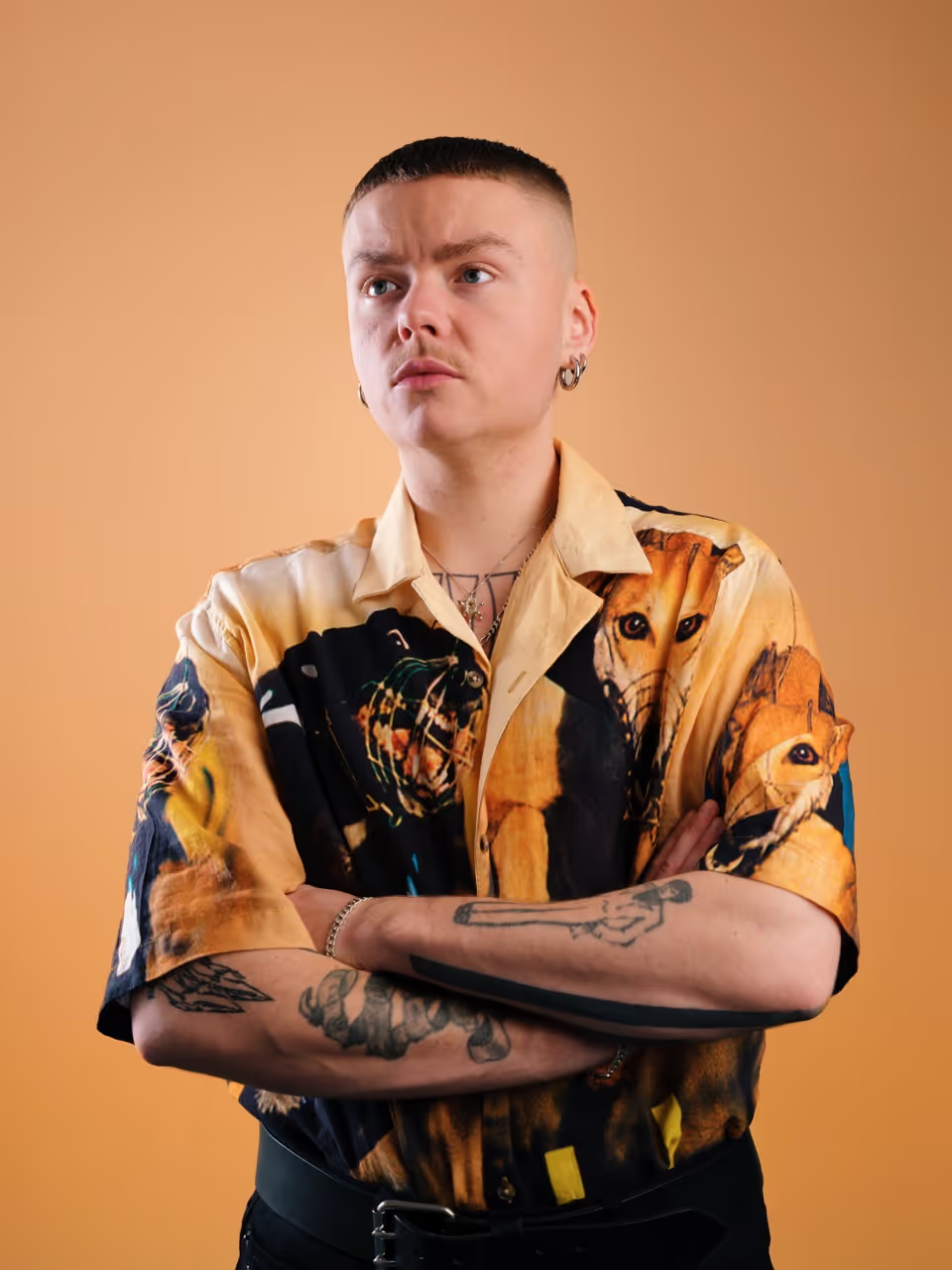
Julius Thissen (1993, the Netherlands) lives and works in Arnhem, NL. Their work investigates themes of community and representation, masculinity, sports, and competition. Originating from their background as a performance artist, Thissen's photographic practice aims to create narratives that explore the fine line between performing and failing. These themes are closely tied to contemporary performance-driven culture and the influence of societal expectations on behavior. Their work is deeply rooted in personal experiences as a genderqueer and transmasculine individual. Thissen strongly opposes the restrictive and often binary narratives imposed on transgender and queer individuals.
Thissen has been nominated for the Hendrik Valk Prize, Arnhemse Nieuwe, and the Warsteiner Blooom Awards. In 2023, they received the Artist Basis Fund and, more recently, a Mondriaan Fund Artist Project Grant for their new project Bones of Graphene, Skin of Kevlar.

Tim Rod is a Swiss artist based in Bern, Switzerland. He studied art education at HKB – Bern University of Applied Sciences (BA, 2018), art history at Bern University (Minor, 2019), photography at Vevey School of Photography (CEPV, ES diploma, 2021) and is currently pursuing a master’s degree in Contemporary Arts Practice at HKB – Bern University of Applied Sciences.
His work often explores issues related to exile and habitat, rootlessness and rootedness, as well as memory, identity, belonging and travelling. His own roots and family history are one of the central elements of his practice and his research, alongside collective visual culture. While his practice remains strongly rooted in photography, his works often expand into site-specific multimedia installations. His work has been exhibited since 2018 in Switzerland and internationally since 2021. Recent exhibitions include "L’Été sans fin" (Festival Images, Vevey, 2020), "Genesis" (Hackney Downs Studios, London, 2021), Charta Bookfestival (Rome, 2021), Photobook Award Encontros Da Imagem (Braga, Portugal, 2021), and the European Photobook Month (Hongkong, 2022). He has been nominated or shortlisted to several major Swiss and international awards. His project "Don’t forget the Knifish" was awarded the special mention of the near.prize 2021. The same year, he won the vfg Young Talent Award for Photography with the project "À demain inshallah".

Thana Faroq is a Yemeni photographer and educator based in the Netherlands. She works with photography, texts, sound, and the physicality of the image itself, as a way to respond to the changes that have been shaping and defining her life, and sense of belonging both in Yemen and the Netherlands. Thana's positioning as a photographer is informed by her reflections on her subject matter, tuning in to other people’s lived experiences with which she continually grows familiar. She also increasingly seeks her own story in the frame. Thana was a recipient of the 2018 inaugural Open Society Foundation Fellowship Grant and Exhibition and the 2019 Arab Documentary Fund supported by the Prince Claus Fund and Magnum Foundation and Zenith magazine reporting grant. In 2020, she published her first book, I don't Recognize Me in the Shadows The book was shortlisted for the Lucie Photobook Prize 2021, and it has also been listed as one of the Interesting Artist & Photographic Books for 2021 by the PhotoBook Journal. Thana received her BA in Government and International Relations from Clark University, and an MA in Photography and Society at The Royal Academy of Art, The Hague.

Yu Shuk Pui Bobby (b. 1994) is a visual artist based between Hong Kong and Oslo. With a collaborative approach to her practice, her work conjures the physical, tangible and affective phenomena associated with biotechnology through combinations of video, text, installation, sculpture, and performance. She often uses speculative fiction to tackle questions of human genetic engineering, reconfiguring perceptions of gender, body and historical discourses of identity. Bobby holds a BA from Hong Kong Baptist University and an MFA from Oslo National Academy of Fine Art. Her works have been in Hong Kong, Norway, Japan, China, Iceland and the USA.